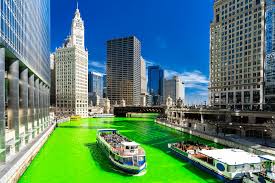
Every year, tens of thousands of people line the streets along the Chicago riverbank to watch over forty pounds of dye transform a quarter-mile stretch of the river into an emerald green body in homage to St. Patrick’s Day. Started in 1962 by the Chicago Plumbers Union to celebrate the holiday, this tradition has gained national recognition and is considered a central component of the city’s celebration of Irish culture.
Yet, the river’s renowned green color was not always associated with St. Patrick’s Day, but rather used as a way to clean up the waste within the river’s waterfront areas. As Chicago developed into an industrialized city, waste management projects for the river further increased; after Mayor Richard Daley took office in 1955, he introduced many environmental initiatives to maintain the river’s cleanliness, one of which being to use green dye to help identify sources of sewage and leaks in pipe connections. Though Daley initially suggested dyeing part of the Michigan Lake green for St. Patrick’s Day, business manager of the Chicago Plumbers Union Stephen M. Bailey convinced him to color the smaller-scale Chicago River instead, launching the 64-year-long tradition that continues to be celebrated today.
First produced as an oil-based product, the brilliant green dye has now shifted to a food-grade, nontoxic powder that is not harmful to the river’s water quality and ecosystems; with a secret formula undisclosed to the public, the powder appears orange before eventually transforming into a green hue once dumped in the water. After experimenting with many methods of distribution, one even involving fire extinguishers, the city eventually settled on spreading the power by two motorboats. One dumps the orange powder into the river, while the other stirs the water, dyeing the stretch of river completely green within minutes.
While the annual river-dyeing has received criticism from environmental activist groups, this Chicago ritual is unlikely to be cancelled any time soon. The City has pushed back against these reproofs, arguing that contamination from heavy rainfalls and sewage overflows presents a legitimate, more urgent concern. Since attracting speculation from other parts of the nation, cities like San Antonio, Tampa, and Indianapolis have now adopted this same practice of dyeing their rivers and canals. Not only does this renowned tradition reflect a city’s festive spirit, but it also more broadly reveals how different regions celebrate, preserve and share culture.