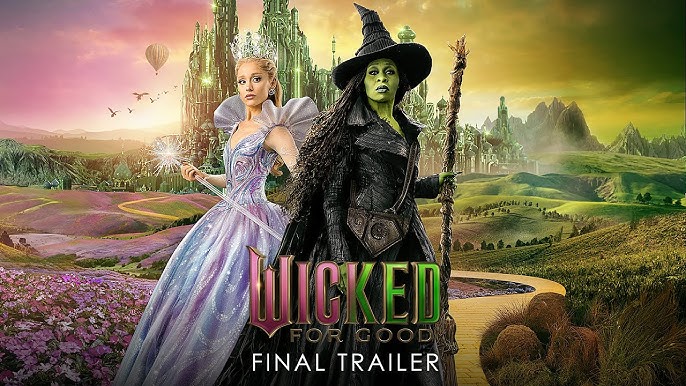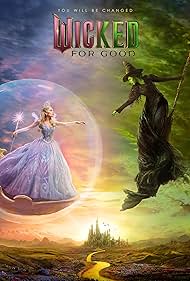
Although audiences were once again whisked back to Oz, Wicked: For Good feels markedly different from its predecessor. Wicked: For Good adopts a darker, more intense tone that raises the emotional stakes for both the audience and the characters. While sequels often struggle to live up to the original, the musical ultimately succeeds as a powerful and satisfying conclusion to an already incredible duology.
Transitioning a story across multiple different mediums is never easy. Wicked began as a novel written by Gregory Maguire, which was inspired by the original The Wizard of Oz. Later, Wicked was adapted into a Broadway musical by Winnie Holzman and Stephen Swartz, quickly becoming a cult-classic. With Wicked: For Good, director Jon M. Chu once again outdoes himself, demonstrating his ability to translate Broadway magic to the big screen. The film maintains the dreamy and almost utopian atmosphere established in the first instalment while layering it with a more sombre tone, expanding the world-building and deepening its emotional weight. Here, Oz begins to feel less like a fantastical pastel wonderland, especially in the forest scenes. The darker colour palette adds a more fractured, paranoid feel to the film.
However, the performances are where Wicked: For Good truly shines. Despite its famously star-studded cast, the characters of the film never feel overshadowed. Ariana Grande’s portrayal of Glinda is particularly impressive; despite her preexisting fame as a pop star, Grande disappears into the role, embodying Glinda’s charm, vulnerability, and growth so completely that she completely becomes the character. Her light, breathy vocals perfectly suit Glinda’s sweetness and internal conflict.
In contrast, Cynthia Erivo’s Elphaba brings a rich, powerful vocal presence filled with velvety vocals and emotional depth. Her performance captures both Elphaba’s resilience and her lingering youthfulness, grounding her character arc in sincerity. Together, Erivo and Grande share extraordinary chemistry, most notably culminating in their duet, “For Good.” Their bond forms the heart of both films, anchoring the story in a portrayal of friendship that feels deeply authentic and rarely explored with this level of depth in popular mainstream cinema, which often favours romantic connection instead.
Jonathan Bailey’s Fiyero is another highlight, capturing both the emotional intensity and physicality of the character with ease. His incredible chemistry with both Glinda and Elphaba adds nuance to the story’s central relationships, allowing for moments of both tension and tenderness to resonate more strongly with the audience.
The film concludes on a bittersweet note. Though Elphaba and Fiyero are ultimately separated from Glinda, who assumes leadership of Oz, it is clear that each and every character has been changed for good by the connections they have shared. Because they have loved, they will always carry parts of that affection with them. As the final moments unfold, it becomes clear that Wicked: For Good is less about grand resolutions and more about the lasting impact of the people who shape us and the choices we make.
Ultimately, Wicked: For Good delivers an unforgettable cinematic experience. While I enjoyed travelling down the Yellow Brick Road once again, it is the film’s sincerity, dedication, and character-driven storytelling that make the journey truly memorable.